
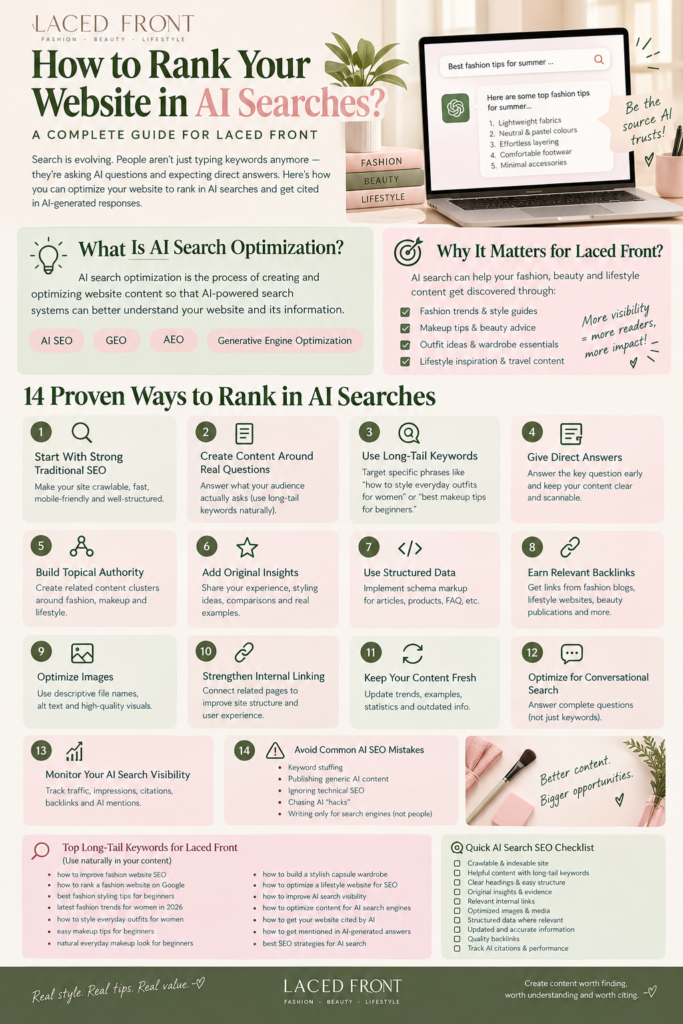
Introduction: Search Is Changing
Remember when searching online meant typing a few keywords into Google and scrolling through pages of results?
That’s changing.
Today, people are increasingly using AI-powered search experiences to ask complete questions and receive summarized answers. Instead of simply looking for a list of websites, users may ask:
“What are the biggest fashion trends for 2026?”
or
“How can I style an oversized blazer for a casual outfit?”
This change creates a new opportunity for websites like Laced Front.
Laced Front is a lifestyle and fashion platform focused on fashion, styling, makeup, and lifestyle inspiration. As AI-powered search becomes more important, creating useful content isn’t just about ranking on traditional search engines. It’s also about making your content easy for AI systems to understand, trust, and potentially reference.
So, how do you rank a website in AI searches?
Let’s break it down.
What Is AI Search Optimization?
AI search optimization is the process of creating and optimizing website content so that AI-powered search systems can better understand your website and its information.
You may also come across terms such as:
- AI SEO
- Generative Engine Optimization (GEO)
- Answer Engine Optimization (AEO)
- AI Search Optimization
The basic idea is simple:
Create content that is useful, clear, trustworthy, well-structured, and easy to understand.
For a fashion website like Laced Front, this could mean creating detailed articles answering questions about styling, fashion trends, makeup, wardrobe essentials, and lifestyle.
Why Does AI Search Matter for Laced Front?
Imagine someone asks an AI search tool:
“What are the best websites for fashion styling inspiration?”
If Laced Front consistently publishes useful, authoritative, and well-structured fashion content, there is an opportunity for the brand to become more visible in these discovery journeys.
AI search can also change how users discover:
- Fashion trends
- Styling guides
- Makeup tips
- Outfit ideas
- Beauty advice
- Lifestyle inspiration
- Travel and lifestyle content
This means improving AI search visibility can become another part of Laced Front’s overall digital marketing and SEO strategy.
1. Start With Strong Traditional SEO
Before focusing on AI search, make sure your basic SEO is strong.
A website needs to be easy for search engines to crawl, understand, and index.
For Laced Front, this means paying attention to:
- Page titles
- Meta descriptions
- H1, H2, and H3 headings
- Mobile responsiveness
- Website speed
- Internal linking
- Image optimization
- XML sitemap
- HTTPS
- Clean website navigation
- Search-friendly URLs
Traditional SEO and AI SEO shouldn’t be treated as competitors.
Good SEO creates the foundation for good AI search visibility.
2. Create Content Around Real Questions
One of the most effective ways to optimize your website for AI search is to understand what people actually ask.
Instead of creating an article targeting only:
“Fashion trends”
Laced Front could create content around questions such as:
- What are the biggest fashion trends in 2026?
- How can I style oversized clothes?
- What are the best casual outfit ideas for women?
- How can beginners build a capsule wardrobe?
- What makeup looks are trending in 2026?
- How can I style one outfit in different ways?
These questions naturally introduce long-tail keywords and conversational search queries.
3. Use Long-Tail Keywords Naturally
Long-tail keywords are especially useful because they are more specific than broad keywords.
For example:
Short-tail keyword:fashion trends
Long-tail keyword:2026 fashion trends everyone will be wearing this year
Another example:
Short-tail:makeup tips
Long-tail:easy everyday makeup tips for beginners
For Laced Front, relevant long-tail keywords can include:
- how to style everyday outfits for women
- best fashion styling tips for beginners
- easy makeup tips for an everyday look
- how to build a stylish capsule wardrobe
- latest fashion trends for women in 2026
- fashion and makeup tips for beginners
- how to style basic clothes in different ways
The key is to use these phrases naturally.
Don’t force a keyword into every paragraph.
4. Give Direct Answers
When someone asks a question, answer it early.
For example:
How Can You Improve Your Fashion Website SEO?
A strong fashion website SEO strategy combines useful content, relevant keywords, technical SEO, internal linking, optimized images, authoritative backlinks, and a clear website structure.
Then explain each point in detail.
This format is useful because visitors don’t have to search through a huge introduction to find the answer.
It also creates content that is easier to understand and scan.
5. Build Topical Authority Around Fashion
If Laced Front wants to rank a fashion and lifestyle website, publishing random articles isn’t enough.
Instead, create related content around your main topics.
Fashion
- 2026 Fashion Trends Everyone Will Be Wearing
- How to Build a Capsule Wardrobe
- Everyday Styling Tips for Women
- How to Style Oversized Clothing
- Wardrobe Essentials Every Woman Needs
Makeup
- Easy Everyday Makeup for Beginners
- Natural Makeup Looks
- Makeup Mistakes Beginners Should Avoid
- How to Create a Simple Day-to-Night Makeup Look
Lifestyle
- Solo Travel Tips
- Lifestyle Habits for a More Organized Life
- Self-Care Ideas for Busy Women
- Fashion and Lifestyle Inspiration
These articles can be internally linked to one another.
Over time, this creates a stronger topic cluster around fashion, beauty, and lifestyle.
6. Add Original Experience and Insights
AI can produce generic fashion advice in seconds.
So why should someone choose your article?
Because your content should offer something beyond generic information.
Laced Front can add:
- Original styling combinations
- Outfit examples
- Fashion trend analysis
- Personal observations
- Product comparisons
- Before-and-after styling concepts
- Original photography
- Practical makeup tips
- Real-world examples
For example, instead of simply saying:
“Neutral colors are versatile.”
Explain how to combine beige, olive, cream, brown, or soft pink pieces to create different outfits.
Specific advice feels more human and more useful.
7. Structure Your Content Clearly
Good content structure makes an article easier to read.
Use a simple hierarchy:
H1
How to Rank Your Website in AI Searches
H2
What Is AI Search Optimization?
H2
Why AI Search Matters for Fashion Websites
H2
How to Optimize Your Website for AI Search
H3
Create Helpful Content
H3
Use Long-Tail Keywords
H3
Build Topical Authority
H2
Common AI SEO Mistakes
H2
Frequently Asked Questions
This structure makes your content easy to scan on both desktop and mobile.
8. Make Your Content Easy to Cite
If you’re wondering how to get your website cited by AI, there isn’t a guaranteed shortcut.
Instead, create information that is genuinely useful as a reference.
For example, Laced Front could publish an article such as:
10 Ways to Style a White Shirt
Rather than writing only general statements, provide specific styling ideas:
- White shirt + straight-leg jeans
- White shirt + tailored trousers
- White shirt + midi skirt
- White shirt + layered vest
- White shirt + denim jacket
The more useful and specific the information is, the more valuable the page becomes to readers.
9. Optimize Images for Search
Fashion is highly visual, so images are extremely important for Laced Front.
Don’t upload images with meaningless filenames such as:
IMG_4827.jpg
Instead, use descriptive filenames such as:
2026-summer-fashion-trends.jpg
Also use meaningful alt text that accurately describes the image.
For example:
Alt text:
“neutral-toned casual outfit styling for women”
Image optimization can improve accessibility while helping search engines better understand the visual content of your page.
10. Strengthen Internal Linking
Internal linking connects related pages across your website.
For example, an article about:
“2026 Fashion Trends”
could link to:
- How to Style Oversized Clothing
- Wardrobe Essentials for Women
- Everyday Fashion Styling Tips
- How to Build a Capsule Wardrobe
This helps readers discover more content and creates a connected website structure.
For Laced Front, internal linking can help connect the fashion, makeup, and lifestyle content pillars into one cohesive content ecosystem.
11. Build Relevant Backlinks
Backlinks can help establish the authority of a website.
But don’t focus on collecting hundreds of irrelevant links.
Instead, look for relevant opportunities such as:
- Fashion blogs
- Lifestyle websites
- Beauty publications
- Guest blogging
- Fashion directories
- Digital PR
- Interviews
- Online communities
- Relevant business listings
For example, a lifestyle publication mentioning Laced Front as a fashion styling resource can provide more meaningful value than an unrelated low-quality backlink.
12. Keep Your Content Fresh
Fashion changes quickly.
A trend that is popular today might look completely different a few months later.
That’s why Laced Front should regularly review important content.
Update:
- Fashion trends
- Statistics
- Examples
- Images
- Links
- Styling recommendations
- Makeup trends
- Outdated information
Don’t update content simply to change its date.
Update it when you have genuinely useful information to add.
13. Optimize for Conversational Search
People don’t always search using short keywords.
They increasingly ask complete questions.
For example:
Instead of:
“summer outfits”
someone might search:
“What are the best casual summer outfits for women?”
Instead of:
“natural makeup”
they might ask:
“How can I create a natural makeup look for everyday wear?”
Laced Front can target these conversational queries by creating dedicated sections and articles that answer them directly.
14. Monitor Your AI Search Visibility
SEO shouldn’t stop after publishing an article.
Track how your content performs.
Look at:
- Organic traffic
- Search impressions
- Click-through rate
- Keyword rankings
- Referring domains
- Backlinks
- Featured snippets
- AI-generated mentions or citations where measurable
You can also search important questions yourself and see which websites are being referenced.
This can reveal content gaps and opportunities for Laced Front.
Common AI SEO Mistakes to Avoid
Keyword Stuffing
Repeating the same keyword unnaturally can make content difficult to read.
Use related phrases and synonyms naturally.
Publishing Generic AI Content
AI can help with research and drafting, but your final article should have a human point of view.
Add your own examples, analysis, experience, and perspective.
Ignoring Technical SEO
Great content can’t perform at its full potential if the website has serious crawling, indexing, speed, or mobile usability problems.
Chasing AI Hacks
There is no magic keyword density or secret formula that guarantees an AI system will mention your website.
Focus on quality and usefulness instead.
Writing Only for Search Engines
Don’t forget the most important audience:
your readers.
If an article is stuffed with keywords but doesn’t help the reader, it isn’t successful SEO.
Long-Tail Keyword Ideas for Laced Front
Here are some additional long-tail keywords that can be incorporated naturally into future Laced Front articles:
| Long-Tail Keyword | Suggested Content |
|---|---|
| how to improve fashion website SEO | SEO guide |
| how to rank a fashion website on Google | SEO guide |
| best fashion styling tips for beginners | Styling guide |
| latest fashion trends for women in 2026 | Trend article |
| how to style everyday outfits for women | Styling guide |
| easy makeup tips for beginners | Makeup guide |
| natural everyday makeup look for beginners | Makeup tutorial |
| how to build a stylish capsule wardrobe | Fashion guide |
| how to optimize a lifestyle website for SEO | SEO guide |
| how to improve AI search visibility | AI SEO article |
| how to optimize content for AI search engines | AI SEO guide |
| how to get your website cited by AI | AI SEO guide |
| how to get mentioned in AI-generated answers | AI SEO guide |
| best SEO strategies for AI search | SEO strategy article |
Frequently Asked Questions
How do I rank my website in AI searches?
Focus on strong technical SEO, useful original content, search intent, long-tail keywords, clear structure, topical authority, internal linking, relevant backlinks, and accurate information.
How do I optimize my website for AI search?
Create content that directly answers real questions, organize it with clear headings, demonstrate expertise, provide original information, and maintain strong SEO fundamentals.
How can Laced Front improve its AI search visibility?
Laced Front can build topical authority around fashion, styling, makeup, and lifestyle by publishing comprehensive guides, answering conversational questions, creating original insights, optimizing images, strengthening internal links, and earning relevant backlinks.
Can long-tail keywords help with AI search?
Yes. Long-tail keywords often represent specific questions and user intent, making them useful for creating detailed content that directly addresses what people are looking for.
Does AI search replace traditional SEO?
No. AI search adds another layer to modern search visibility, but technical SEO, quality content, relevance, authority, and a strong user experience remain important foundations.
Final Thoughts
The future of search isn’t simply about being number one on a search results page.
It’s about becoming a useful and recognizable source of information.
For Laced Front, that means going beyond simply publishing fashion articles. Build a website that answers real questions about fashion, styling, makeup, and lifestyle, while giving readers practical ideas they can actually use.
Create content that is:
Useful. Original. Clear. Trustworthy. Human.
That’s the real foundation of an effective AI SEO strategy.
And as search continues to evolve, the brands that focus on genuinely helping people will have the strongest opportunity to remain visible—whether someone finds them through a traditional search engine or an AI-powered answer.